

ASETS Completes Vector Institute FastLane Program
ASETS-CA has formally concluded its participation in the FastLane program, making a defined step in strengthening its applied artificial intelligence capabilities within engineering environments.
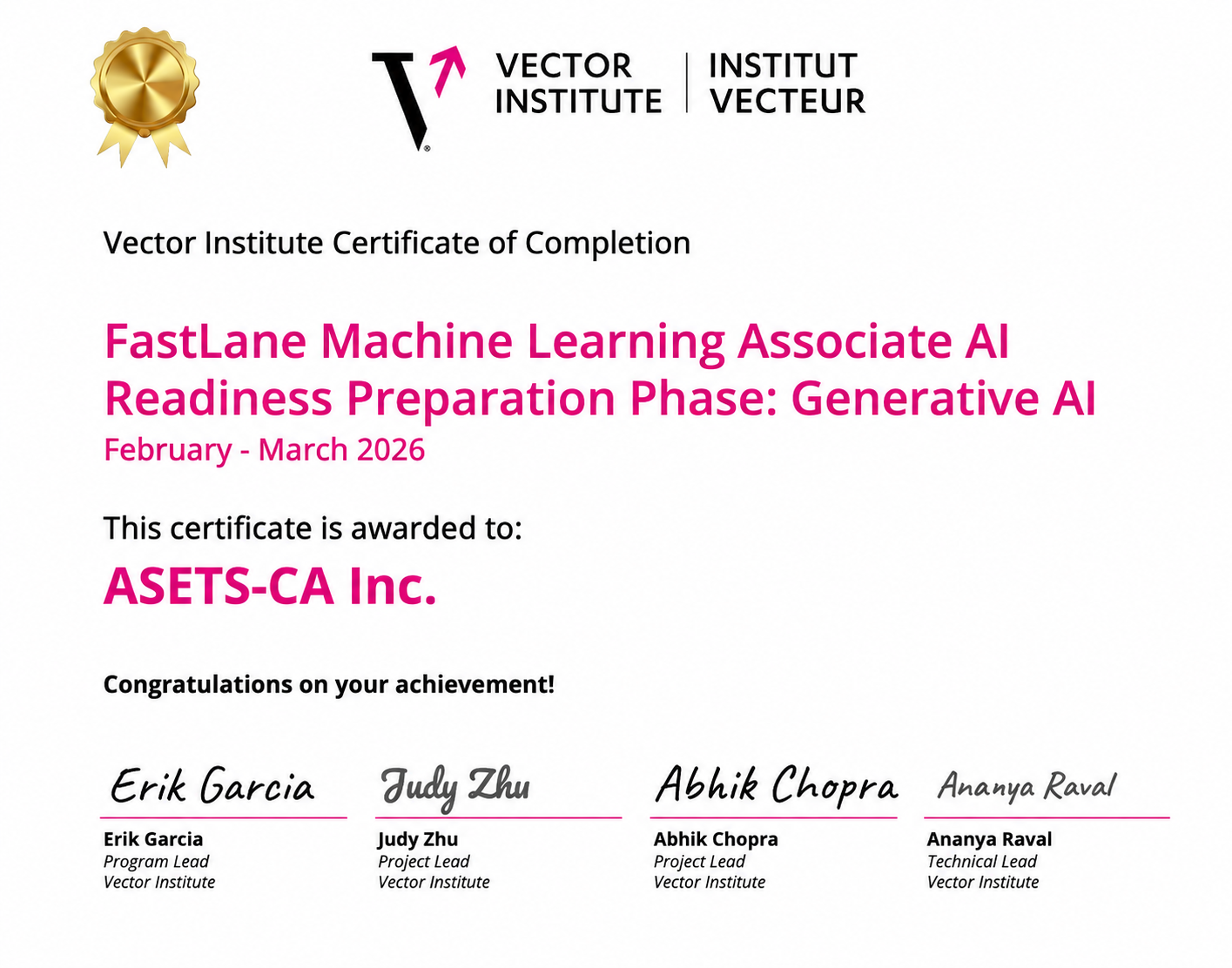
ASETS-CA has formally concluded its participation in the FastLane program, marking a defined step in strengthening its applied artificial intelligence capabilities within engineering environments. The program centred on preparing organizations to operationalize Generative AI in production settings, with an emphasis on practical deployment rather than theoretical exploration.
For ASETS, this phase has been directed toward refining how intelligence is embedded within engineering workflows, particularly in the early stages of model creation and validation. The effort aligns with the company’s broader objective of enabling teams to move from raw scan data to usable CAD outputs with greater speed and operational clarity.
What the program contributed
The FastLane engagement provided structured technical guidance and access to a broader AI ecosystem. This has supported ASETS in three immediate areas:
- Strengthening internal approaches to applying machine learning within scan-to-model workflows
- Improving the reliability and consistency of early-stage CAD model generation
- Aligning product direction with practical industry requirements rather than experimental features
These outcomes directly reinforce the current development path of IDS™ Halo, where the emphasis remains on accelerating the creation of foundational CAD models that stakeholders can rely on before detailed engineering begins.
Why this milestone holds weight
ASETS is building an engineering technology that allows teams to convert scan data and existing documentation into structured CAD and BIM deliverables within a single working environment. The central problem addressed is the fragmentation between data capture, modelling, and validation, which often leads to delays, rework, and limited visibility across stakeholders.
Completion of the FastLane program signals that ASETS is progressing with a disciplined approach to integrating AI into this workflow. It reflects alignment with industry expectations for dependable, production-ready solutions rather than experimental tooling.
What follows
In the coming months, ASETS will continue to translate these learnings into product-level improvements within IDS™ DataOps. The near-term direction includes advancing modelling efficiency, refining validation workflows, and expanding applicability across project types. The emphasis remains on delivering measurable improvements to how engineering teams handle complex assets, with AI applied where it produces clear operational value.


30 Knowledge Park Dr, Suite 320
Fredericton, NB E3C-2R2
Canada
2, Faehrbongerten
L-5698 Welfrange
Luxembourg

© 2026 ASETS