

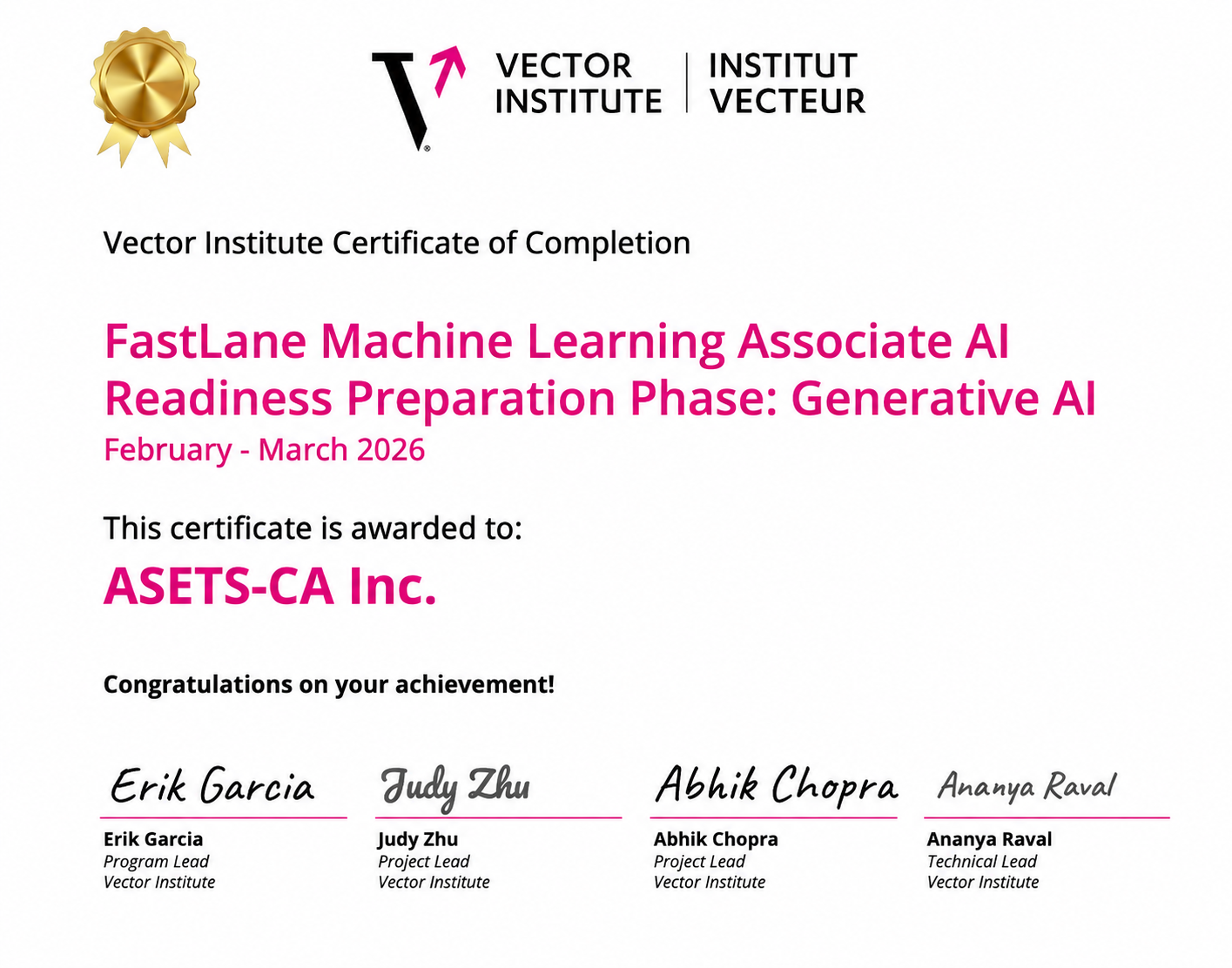
ASETS-CA Completes Vector Institute FastLane AI Program
ASETS-CA Inc. has received its Certificate of Participation following the completion of the Vector Institute FastLane Machine Learning Associate Program: Gen AI & Agentic AI Cohort, which ran from May 11 to August 28, 2026.
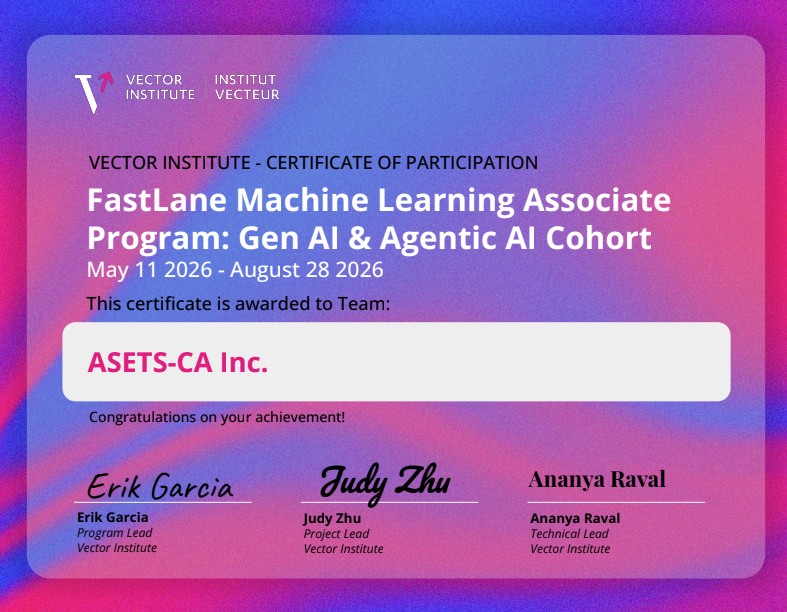
The completion represents another step in ASETS’ continued development of practical artificial intelligence capabilities for engineering applications. Rather than treating AI as a standalone technology, ASETS is focused on applying it to defined engineering tasks where it can improve how information is interpreted, structured, validated, and used within industrial engineering project workflows.
What the program contributed
The FastLane program provided ASETS with exposure to Generative AI, Agentic AI, and approaches for moving AI applications from development into practical operating environments.
The engagement supported several areas relevant to ASETS’ technology development:
- Expanding internal knowledge of Generative and Agentic AI architectures
- Strengthening approaches to engineering data extraction and interpretation
- Exploring more structured automation across multi-stage engineering workflows
- Improving how AI-assisted processes can be evaluated for reliability and production use
These capabilities complement ASETS’ existing work across the IDS™ product suite, where engineering information from scans, models, drawings, and project documents is progressively converted into usable digital engineering outputs.
Why this milestone holds weight
Engineering projects often involve large volumes of information distributed across point clouds, drawings, models, equipment data, and other technical records. Extracting value from these sources requires more than digitization. It requires reliable methods for identifying relationships, detecting inconsistencies, and directing engineering attention toward the information that requires review.
The FastLane program strengthens ASETS’ ability to examine where Generative and Agentic AI can contribute to these processes in a controlled and technically useful manner.
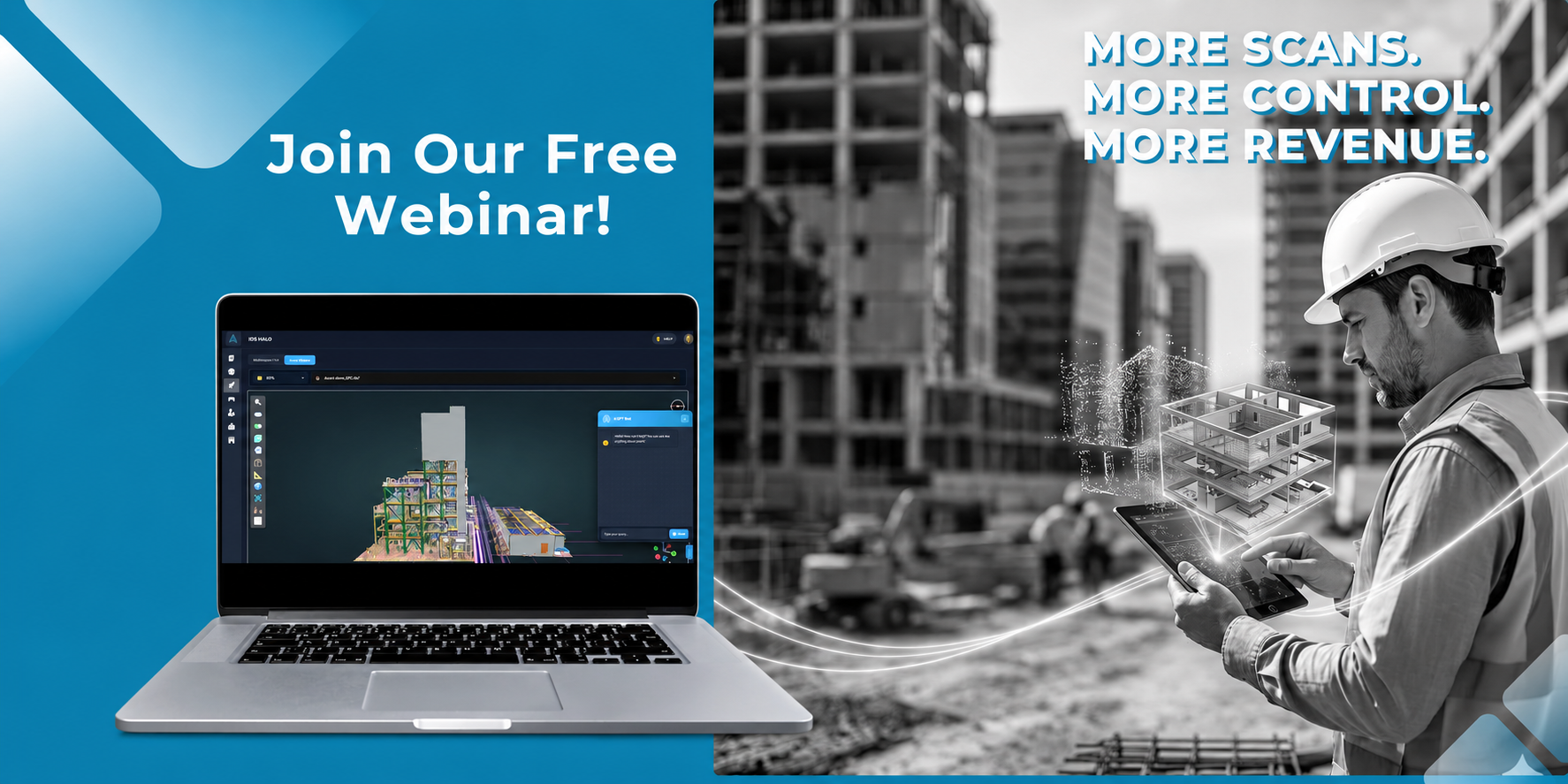
This is particularly relevant as ASETS continues developing workflows that connect scan data, CAD/BIM model creation, engineering information, and validation within the IDS™ environment. IDS™ Halo, for example, is currently positioned around progressing scan data into foundational CAD/BIM deliverables before detailed engineering begins.
What follows
ASETS will continue translating the technical knowledge developed through the program into practical applications across its product development activities, including IDS™ DataOps, IDS™ Halo, and associated engineering workflows.
Near-term work will remain centred on improving engineering data interpretation, model development, validation, and workflow automation, with each application assessed according to the operational value it provides to engineering teams.
ASETS also acknowledges the contribution of the Vector Institute team throughout the program, including Erik Garcia, Program Lead; Judy Zhu, Project Lead; and Ananya Raval, Technical Lead, whose guidance supported the cohort from program delivery through completion.


30 Knowledge Park Dr, Suite 320
Fredericton, NB E3C-2R2
Canada
2, Faehrbongerten
L-5698 Welfrange
Luxembourg

© 2026 ASETS